


An Implant Bridge Example: What Treatment Looks Like
A missing tooth at the front of your smile is hard to ignore. Several missing teeth at the back can make chewing feel uneven, change the foods you choose and place extra pressure on the remaining teeth. An implant bridge example helps make the solution easier to picture: rather than replacing each missing tooth with a separate implant, a carefully planned bridge can be supported by implants at key points.
For many patients, this offers a fixed, natural-looking alternative to a removable denture or a conventional bridge that relies on neighbouring teeth. The right approach depends on the number and location of missing teeth, the condition of your jawbone and gums, your bite, and your long-term goals.
Implant Bridge Example: Replacing Three Missing Teeth
Imagine you have lost three adjacent lower molars. With a conventional dental bridge, the dentist would usually need to prepare a tooth on either side of the gap for crowns. Those crowned teeth would then carry replacement teeth between them. This can be an appropriate treatment in some situations, particularly where the supporting teeth already need crowns, but it does require healthy natural teeth to take on the load.
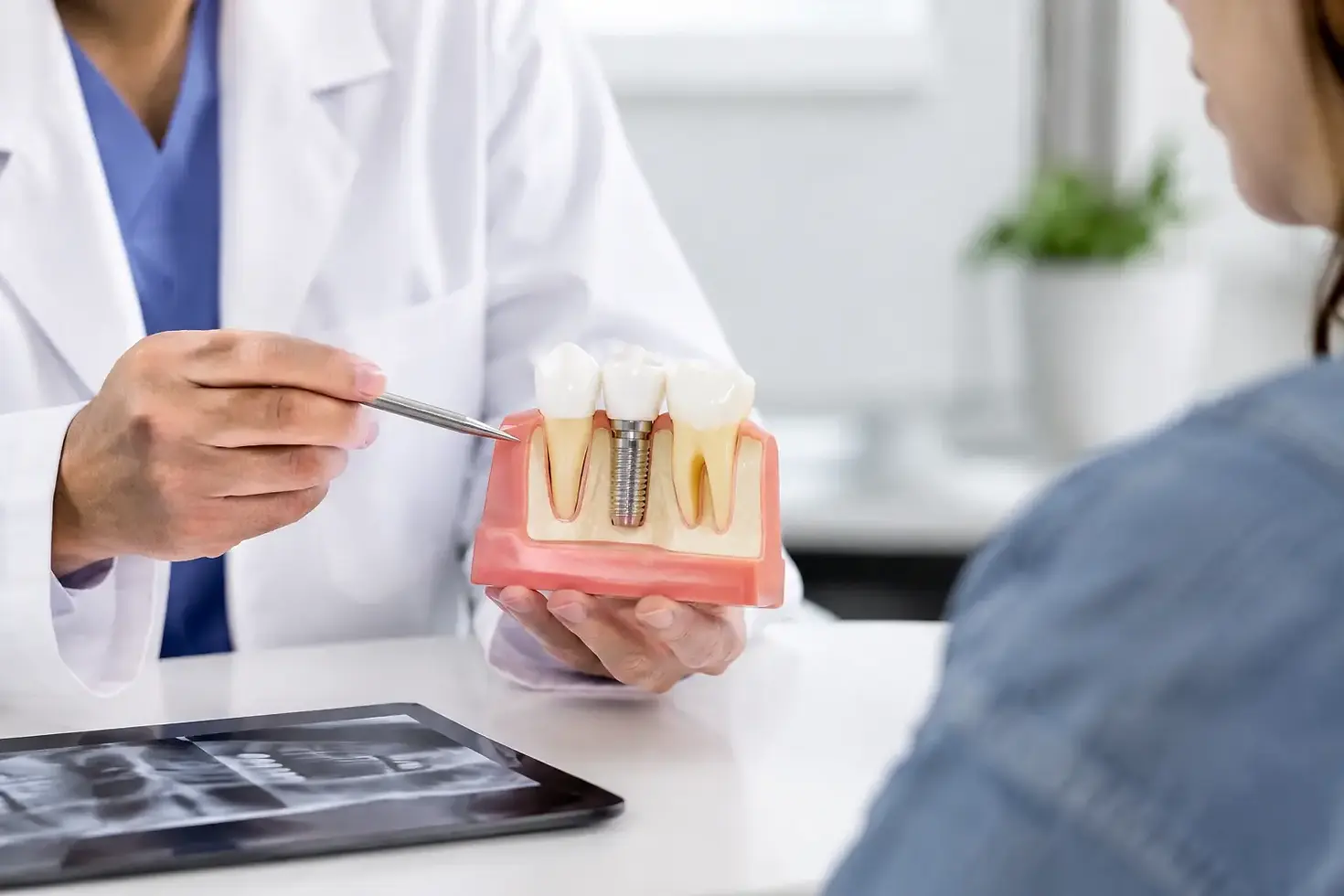
An implant-supported bridge takes a different path. Two dental implants may be placed in the jawbone, one toward each end of the three-tooth space. After the implants have integrated with the bone, a custom three-tooth bridge is secured to them. The implants act as artificial tooth roots, while the visible bridge restores the chewing surfaces and appearance of the missing teeth.
The middle replacement tooth is supported by the bridge structure rather than having its own implant. This means a three-tooth gap does not always require three implants. It can reduce the number of surgical sites while still providing a stable, fixed result. Whether two implants are suitable is a clinical decision, not a one-size-fits-all rule. Bite forces in the back of the mouth are significant, so the design, materials and implant positions must be planned precisely.
A similar approach may be used for front teeth, although aesthetics become even more critical. The bridge must be shaped to complement your smile, lip support and gumline. Colour, translucency and the way the teeth emerge from the gums all matter. A well-made restoration should look proportionate and feel comfortable, not bulky or artificial.
How an Implant-Supported Bridge Is Planned
Successful implant treatment starts well before an implant is placed. Your dentist assesses the mouth as a complete system, rather than simply filling a gap. This includes a clinical examination, gum assessment, bite analysis and detailed imaging to evaluate available bone and identify important anatomical structures.
If a tooth has only recently been removed, the timing of implant placement can vary. In selected cases, an implant may be placed at the time of extraction. In others, allowing the area to heal first is safer or more predictable. If bone has reduced after tooth loss, bone grafting may be recommended before or alongside implant placement. This can add time to treatment, but it may create a stronger foundation for the final bridge.
After implant placement, a healing period is usually needed for osseointegration - the process where bone forms a secure connection with the implant surface. During this stage, a temporary tooth or temporary bridge may be used when appropriate, particularly in visible areas. Once the implants are stable, precise impressions or digital scans are used to design the final bridge.
At Master Dental, treatment planning is focused on precision, comfort and durability. Modern imaging and digital workflows help us assess the proposed implant positions and create restorations that work with your bite. For nervous patients, a calm, clear explanation of each stage matters just as much as the technology.
What the final bridge is made from
The final bridge may be made from high-strength ceramic, zirconia, porcelain bonded to another framework, or another material selected for the clinical situation. Back teeth need strength to withstand chewing. Front teeth often demand more attention to natural light reflection and fine colour matching.
The bridge can be screw-retained or cement-retained. Screw-retained designs often allow easier access if the bridge needs to be removed for maintenance or repair. Cement-retained bridges can be useful in particular positions, but excess cement must be carefully managed as it can irritate tissues around implants. Your dentist will recommend the design that best suits the position, angulation and health of your gums.
What an Implant Bridge Can and Cannot Do
An implant bridge can restore the ability to chew more confidently, support a balanced bite and reduce the need to alter neighbouring healthy teeth. Because implants transmit chewing forces into the jawbone, they may also help preserve bone in the area of tooth loss. Many patients value the secure feeling of a fixed bridge compared with a removable appliance.
However, implants are not maintenance-free. They cannot decay like natural teeth, but the gums and bone around them can become inflamed if plaque is allowed to build up. This condition can progress and threaten implant stability. Daily cleaning around the bridge, including under replacement teeth where advised, is essential. Interdental brushes, specialised floss or water-cleaning devices may be recommended depending on the bridge design.
Regular professional reviews are equally important. Your dentist checks the gum tissues, bite, bridge surface and components over time. Teeth can shift, biting habits can change, and a bridge may need minor adjustment to keep forces even. If you grind or clench your teeth, a protective night splint may be advisable.
Smoking, poorly controlled diabetes, active gum disease and heavy grinding do not automatically rule out implants, but they can affect risk and planning. Existing gum disease should be stabilised before proceeding. The most predictable result comes from treating the causes of tooth loss as well as replacing the teeth themselves.
Implant Bridge or Separate Implants?
For a gap involving two or three teeth, some patients ask whether every tooth should have its own implant. Separate implants can offer individual tooth replacement and may make cleaning between teeth feel more familiar. They also avoid joining the teeth together. Yet more implants are not automatically better. Available bone, tooth position, cost, anatomy and bite forces all influence the decision.
An implant bridge may be a highly efficient option where implants can be placed at strong anchor points and the span is suitable. It may also be preferable when there is limited room for separate implants. On the other hand, a longer bridge spanning many missing teeth needs careful engineering. Larger spans can flex under force, so a dentist may recommend additional implants, a different bridge design or another treatment altogether.
The best answer comes from a tailored assessment. A treatment plan should explain why a certain number of implants is recommended, what material will be used, the expected stages, and how to care for the completed restoration. You should also receive a written estimate in Australian dollars that reflects your individual needs, including any preparatory treatment such as extractions, grafting or temporary restorations.
Is an Implant Bridge Right for You?
You may be a candidate if you have one or more adjacent missing teeth, healthy or manageable gum conditions, and enough bone to support implants or suitability for grafting. Good general health and a commitment to daily oral hygiene are also important. Age alone is rarely the deciding factor. Bone health, healing capacity and oral health are more relevant.
If you have been living with a gap, a loose denture or a failing old bridge, you do not need to guess at the options. A thorough consultation can show you what your own implant bridge example could look like, including the likely treatment sequence and realistic outcome. Replacing missing teeth is not only about filling a space - it is an opportunity to restore comfort, confidence and reliable function for the years ahead.